

Athletic Capital
You have five asset classes. Not one.


Most athletes view their body as their one asset class. In many ways, at least outwardly, it is the first order of business.
In reality, you’re managing five. And every decision made can build some, cost some, or both.
THE FIVE
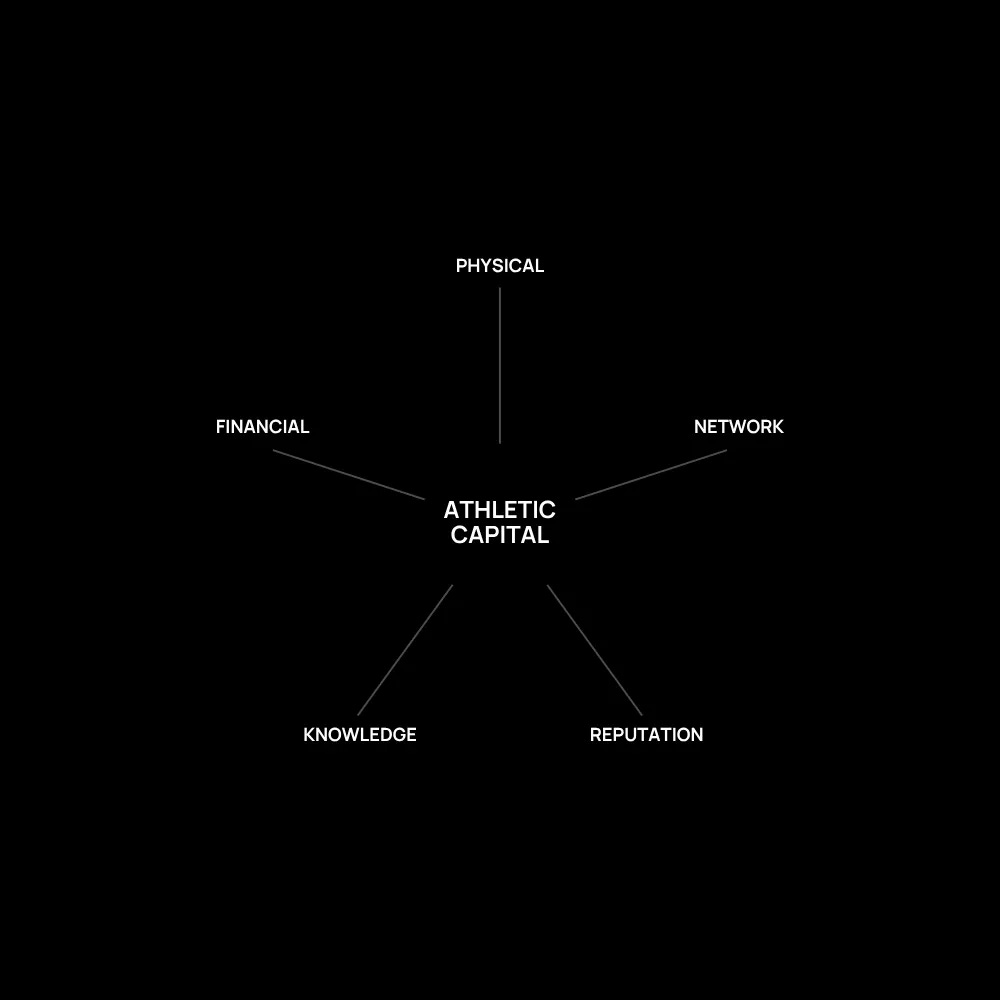
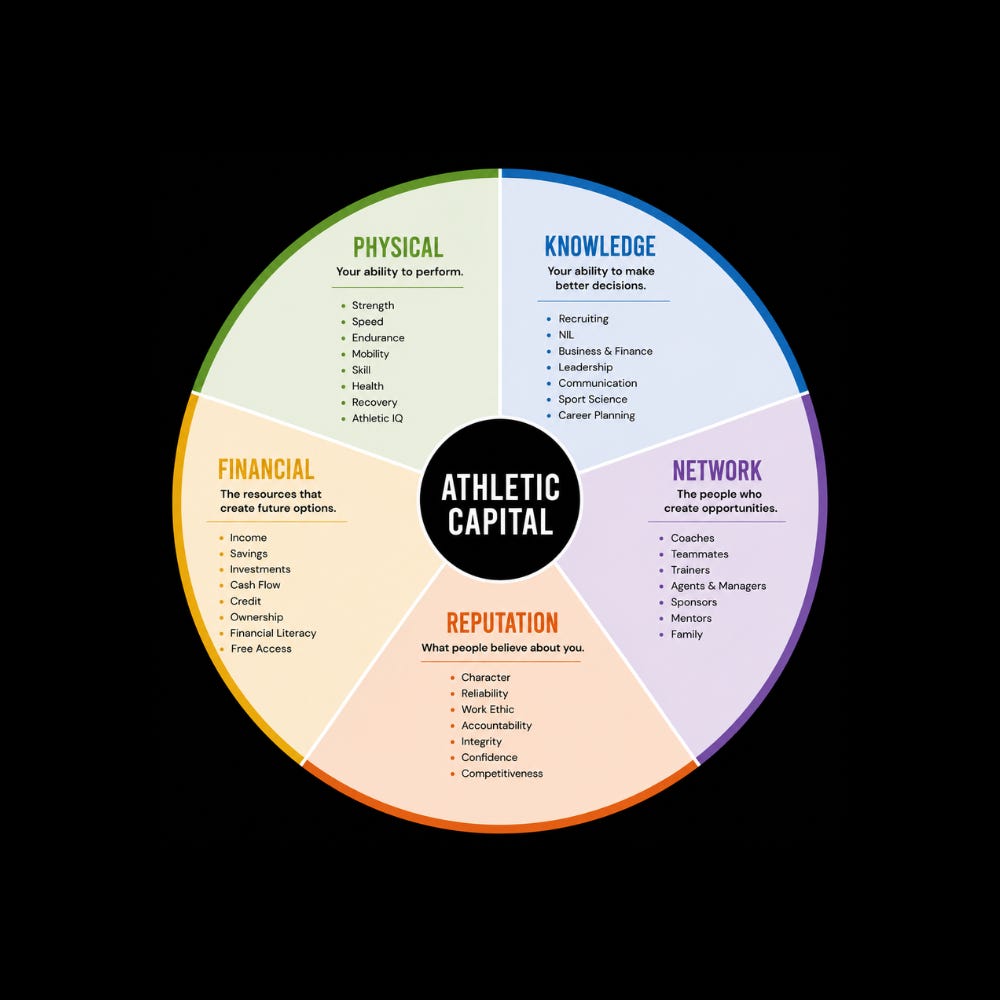
Physical: what you can do.
Knowledge: what you know.
Network: who you know.
Reputation: what people think of you.
Financial: what options you can afford.
Each asset class has a long list of attributes (personal brand, earning potential, health, character, etc). We’ll work through the attributes of each asset class another time as I don’t want to turn this essay into a dictionary.
The point of the wheel is for it to be simple enough to hold in your head during a conversation with a coach, an agent, your parents, or anyone else involved in your career.
THEY DON’T BEHAVE THE SAME
Each asset class possesses differing properties:
Physical grows for a period of time, then begins to decay - your career arc. In shorter terms, stop training for six weeks and maybe you begin to lose your edge.
Knowledge almost never decays. What you learn about contracts at twenty will likely remain true at forty.
Network compounds. One good relationship produces the next, which produces the next five, which produces the next ten, and so-on.
Reputation is extremely fragile and it compounds slowly. Ten years to build. One night to torch.
Financial compounds mathematically. Up or down.
EVERY DECISION IS A POTENTIAL TRADE
Athletes tend to sort decisions into “good” and “bad.” A better way to view it is: What did this build, and what did it cost?
Skip the offseason showcase to recover. Builds physical capital. May cost network capital.
Sign with the first agent who calls. Saves time. May cost financial and knowledge capital.
Skip team lifts because your private trainer has you covered. May build physical capital. May cost reputation capital with your coaches.
Become the league’s bad boy. May build reputation with one audience while destroying it with another. May limit or enhance future financial opportunities.
None of these decisions are inherently right or wrong. Every decision shifts your portfolio in one direction or another.
Nothing remains static.
WEIGHTS
The weight (or importance) of an asset class depends on your objectives and the situations surrounding them.
If your number one priority is your on the field performance: physical and knowledge lead, network may be matter a little less, and personal brand may be least important.
If you’re more interested in building a money-making personal brand: reputation dominates, physical matters but may not be as important. Knowledge (market knowledge) obviously matters a lot.
Building a business while you play: network (partners or help) and financial lead, knowledge matters a lot, and physical likely helps for brand longevity, but possibly less important.
Same five assets. Different weights for different situations.
Potential: Weights can also be viewed as a snapshot in time that determines ones potential.
Example: an individual who is young, physically dominant, funny, and makes way less money could possess much greater earning power than someone who’s currently raking it in financially and has peaked physically.
Same five assets. But certain assets alone can enlarge the pie chart that reflects your potential (hence power-laws).
COMPOUNDERS
What you choose to do often matters most. As we’ve seen, chasing certain things can cost others.
But, in the same way investors love compounding interest, it would benefit any athlete to think of compounding assets.
Your network expands your knowledge (or your access to it).
Your knowledge protects your finances, your body, or other assets.
Your physical performance grows your options for everything (the power-law).
Your reputation can attract better relationships.
If played well, your five assets stop growing independently and begin reinforcing one another.
That’s where careers accelerate. And this often occurs when you tend to focus on one or two things (your super powers) and make the remainder respectable, delegate them to those you trust (with your oversight, of course), or pull the levers in a way that enhances all.
It’s an art.
IT’S UNIVERSAL
This framework can be applied to any level in any situation. Financial can be paired down for younger athletes considering the fact they likely don’t have much (or any) earning power yet. I understand a parent might elevate financial for opportunity reasons. But I’ve seen too many broke athletes make it, and get opportunities at a young age for that to be an absolute.
Use this as a compass, a guide, a framework.
In the athlete’s world, nobody is handed a portfolio. You’re building one whether you realize it or not. The only question is what you choose to do with it.

Onward and upward!
—Ryan
CTA: If there’s anything specific you would like me to write about just reply to this email, or ping me at requests@innoathlete.com
INNO ATHLETE
Helping athletes think clearly about performance, strategy, and business.
Connect: Website | Tiktok | Instagram | Facebook | X | LinkedIn | Spotify | Store