




If you’re a college or even a high school athlete with meaningful NIL opportunities, or you’re about to turn pro, you’re probably thinking about creating, or expanding your team.
Welcome to your first business venture. CEO of you.
Typically, the agent is the first go-to hire. Makes sense (and you likely already did this). Then, other roles begin to form in your little startup (i.e. you). Enter business manager.
I think it’s important to note that not every money-making athlete needs a business manager. But once things become more complex and you find yourself juggling sponsors, appearances, travel, content, etc., having someone focused on operations is nice.
(THE START) OF YOUR ORGANIZATIONAL CHART
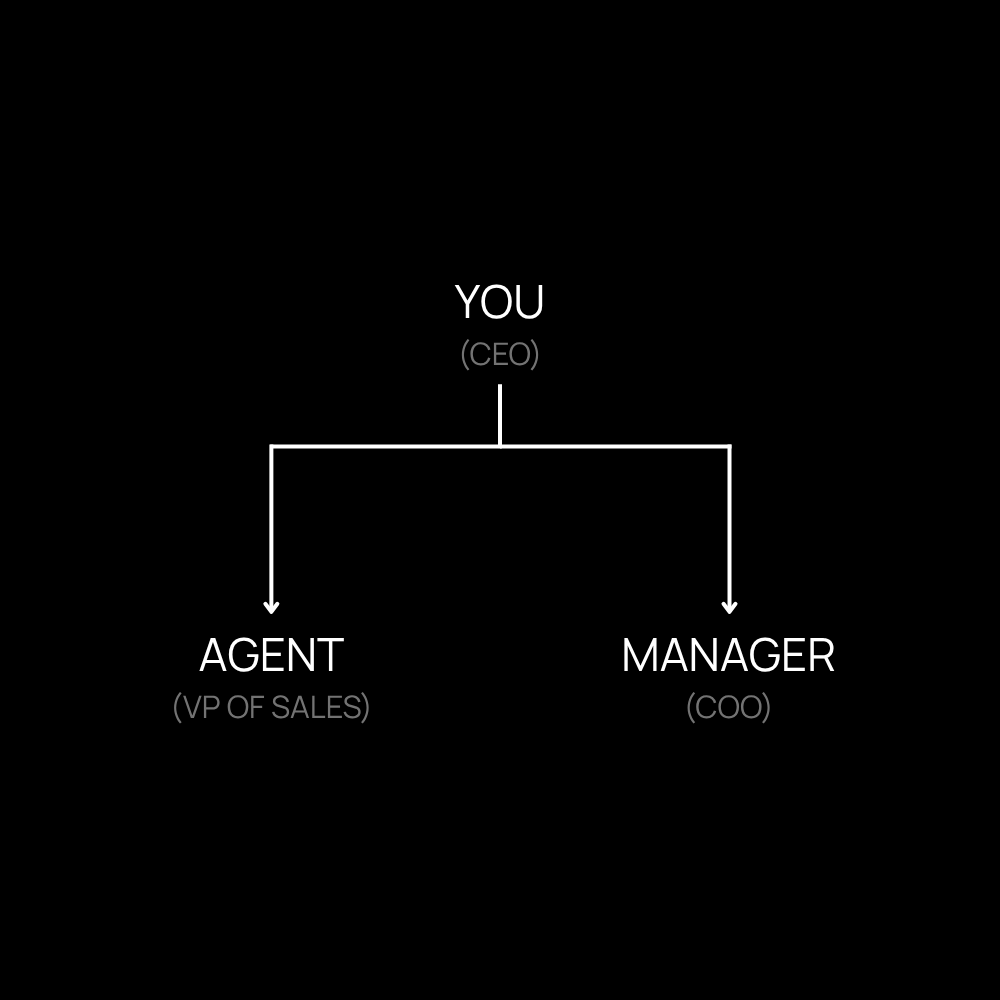
Your agent’s job is representation. Full stop. Think of them as the VP of Sales with a bit more power (legally and otherwise).
Negotiates your contracts
Finds and closes business opportunities
Protects your legal and financial interests
Sits across the table in negotiations, representing you directly
Holds the appropriate licenses where required. This varies a lot by state. Some require registration. And unlike the major pro leagues, the NCAA doesn’t certify NIL agents at all, so “certified” isn’t really a thing to look for here.
In practice: sponsorships, endorsement deals, brand relationships, compliance issues in your sport and region, new opportunities as they surface.
Your agent’s whole job is to grow your value and protect it.
Your manager’s job is execution. Think operator, not visionary. Closer to a COO (Chief Operating Officer).
Runs the day-to-day
Coordinates your team (including you in many cases)
Handles scheduling and communication
Keeps projects moving
Thinks strategically about your brand and career
Also protects your financial interests
Your manager’s job is to make your career run smoothly.
WHERE THINGS BREAK
Your agent starts trying to make management decisions.
Your manager starts trying to negotiate on your behalf.
A manager can flag opportunities to your agent. That’s healthy. But your agent is the owner of the solicitation and negotiation process. They make the call.
There’s a big (and legal) difference between recognizing, and producing opportunities. Producing falls in the realm of solicitation. Recognition is simply awareness.
Similarly, there’s no problem with your agent making recommendations to your manager. Again, healthy. They hold the relationship with your sponsors and understands their expectations. But your manager should be making the final call with things like schedule and coordination.
Example: A sponsor wants a shoot on Tuesday. The agent negotiates the terms. The manager decides whether Tuesday fits your training schedule, travel, and existing commitments.
PROTECT THE LANES
Mix a few responsibilities if you want. In practice that’s more realistic. We’re humans, not robots. Outside input is generally a good thing. But you need a rule for what happens when responsibilities blur.
There needs to be accountability for when things go wrong.
If a decision could create legal or financial exposure (contract terms, compensation, exclusivity clauses) > that’s your agent’s call, always.
If a decision only affects your time and logistics (which day, which city, which slot on the calendar) > that should be your manager’s call.
If it touches both (a sponsor wants exclusivity and a same-week shoot) > your agent negotiates the terms, your manager greenlights the timing, and neither moves without the other.
When responsibilities genuinely overlap, you need a tie-breaker type process or rule.
The simplest version: your agent has final say on anything with a signature attached. Your manager has final say on anything with a date attached. If it’s still unclear, it comes to you. After all, you are the CEO.
Agent: creates, negotiates, maintains brand relationships, leverages opportunities.
Manager: executes and maximizes the business (marketing, revenue, etc.)
You: own the vision, make the final call, and break ties when the first two disagree.
THE FRIEND TRAP
There’s nothing wrong with your manager becoming your friend. I think that can be a good thing. But, make a friend your manager and you could be in a world of hurt (unless, of course, it was previously their occupation).
Hiring friends usually starts with good intentions.
A friend begins helping with travel. Another offers to answer emails. Someone else starts talking to brands because “they know people.” Before long, responsibilities overlap, accountability disappears, and in some cases people begin stepping into areas that carry legal or contractual implications.
Obviously, you want to like the people you’re working with. But don’t make it the point.
Because your agent and manager play the biggest roles in your career, you want them to be true professionals.
BEFORE HIRING
There are a ton of business books that address the hiring process (best practices, what questions to ask, social Q’s to look for, etc.).
I’m certainly no expert in hiring, but friends (I seriously trust) have made some recommendations (none of which I’ve actually read):
Who: The A Method for Hiring by Geoff Smart and Randy Street (2008)
Hire with Your Head: Using Performance-Based Hiring to Build Great Teams by Lou Adler (original ~1998, with later editions)
I hope they’re useful.
And, here’s a great episode around hiring great talent with Tim Ferriss and Graham Duncan. I simply enjoyed the conversation. But it’s obvious that Duncan is obsessed with the hiring process. Worth the listen.
LET’S WRAP THIS UP
The agent owns sponsorships, negotiations, and outreach. The manager owns operations. You own the vision.
Oh yeah, and there’s pay. Agents earn commission (upside). Managers are more often fee-based (flat rate).
Your goal shouldn’t be to build a large team. It should be to build a lean machine. Where every person owns a clear job. The tighter the lines, the better the collaboration, and the better the outcomes.
INNO ATHLETE
Helping athletes think clearly about performance, strategy, and business.
Connect: Website | Tiktok | Instagram | Facebook | X | LinkedIn | Store