

Where Did The Originals Go?
A Declaration


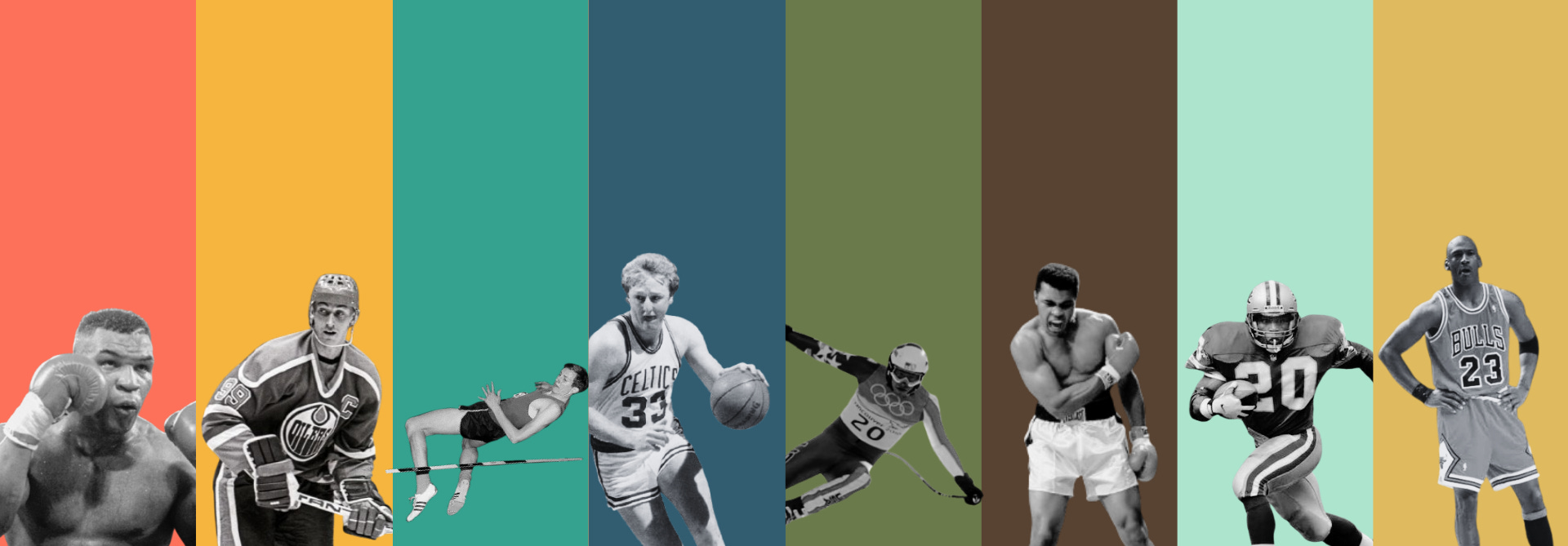
Sports has an originality problem.
Not a talent problem.
Not a resource problem.
Not an access problem.
For over half a century, every generation seemed to produce athletes who permanently changed their sport. They weren’t just great. They became reference points. Every kid wanted to imitate them, every competitor had to adjust to them, and every generation wondered who would come next.
Today we have more resources than ever before. More coaching. More science. More specialists. More information. More travel teams… More opportunity.
Yet the athletes who innovate or show us something wholly different have become increasingly rare.
We’ve become remarkably good at producing exceptional athletes—and surprisingly poor at producing transformational ones.
Perhaps the problem is that these athletes were never something we produced in the first place.
I. THE AGE OF OPTIMIZATION
The last twenty or so years have been a relentless pursuit of optimization.
Better training.
Better branding.
Better coaching.
Better media training.
Better analytics.
Optimization excels at producing exceptional athletes. But it doesn’t show us what’s possible. And it has a tendency to converge.
When everyone takes in the same information, follows the same developmental path, and chases the same metrics, they begin making the same decisions.
The outcome is predictable.
And fewer genuinely surprise us.
Somewhere along the way, sports confused optimization with innovation.
They’re not the same thing.
Optimization raises the floor.
Innovation raises the ceiling.
II. THE FACTORY
Modern athlete development increasingly resembles a factory.
Factories exist to reduce variance. To eliminate mistakes and standardize outcomes.
The modern athlete is expected to join all the same programs, go to all the same events, market themselves the same way, pursue the same partnerships, and often even speak the same way.
Everyone seems to be aping everyone.
Athletes arriving through increasingly similar experiences, making increasingly similar decisions, and becoming increasingly similar expressions of excellence.
Where is Bode Miller!?
III. THE ORIGINALS
The greats were never built from the same blueprint.
Their stories were wildly divergent.
Their childhoods were different.
Their personalities were different.
Their flaws were different.
Their career choices were different.
Michael Jordan didn’t remind us of someone else.
Larry Bird didn’t.
Muhammad Ali didn’t.
Wayne Gretzky didn’t.
Barry Sanders didn’t.
They didn’t become memorable because they perfectly executed someone else’s formula.
They became memorable because no one had ever seen anything quite like them.
They left legacies of permission.
Many of today’s greatest athletes often arrive trying to be like, or comparing themselves to someone else.
Perhaps the most gifted player of his generation entered the league wearing 23.
Signed with many of the same companies.
Followed the same branding playbook.
Even acted in a different version of the same movie.
Pretty hard to beat the OG-23 at his own game.
IV. THE HIDDEN COST OF SAMENESS
When everyone is chasing the same opportunities, using the same methods, the herd instinct kicks in.
They compete for the same scholarships.
The same roster spots.
The same endorsements.
The same attention.
They become interchangeable.
Originality is deceptively hard.
We’re hardwired to follow the pack.
But the pack is where competition is greatest.
Skipping out might be the beginning of a new way.
A better way.
Your way.
VI. THE LABORATORY
The future doesn’t belong to athletes who simply execute the current blueprint better than everyone else.
It belongs to athletes willing to explore beyond it.
Yes, sports needs discipline.
It needs methodology.
It needs universal truths.
But it also needs environments where curiosity is encouraged.
Where experimentation isn’t viewed as failure.
Where independent thinking isn’t always treated as an unnecessary risk.
Not just because every transformational athlete began as an experiment.
But because curiosity and experimentation has always preceded every meaningful breakthrough, and every unique career path.
New ways of performing.
New professional opportunities.
And sometimes new markets.
THE WAY FORWARD
I believe the best careers are self-authored.
The decisions athletes make during their careers shape the way they perform, the businesses they build, the relationships they foster, and the lives they ultimately lead.
There are principles every athlete should learn, but very few paths every athlete should follow.
No blueprint can tell an athlete who they are, what motivates them, or what they’re capable of becoming. It can only show them what worked for someone else.
Agency is the advantage.
Sometimes that means following convention. Sometimes it means walking away from it.
But it always means refusing to outsource judgment.
Knowing the difference is what separates athletes who simply participate from those who leave their mark.
If sports has become too eager to hand athletes blueprints, then the answer isn’t another blueprint.
It’s helping athletes understand the landscape well enough to chart their own course.
That’s the experiment I believe is worth running.
Because athletes with agency don’t just build better careers.
They make room for the originals the next generation is looking for.
INNO ATHLETE
Helping athletes think clearly about performance, strategy, and business.
Connect: Website | Tiktok | Instagram | Facebook | X | LinkedIn | YouTube